Ethics Book for Case Management Frames a Vivid Ethics Spectrum

Ethics book aligns ethical, legal, and regulatory practice for Case Management

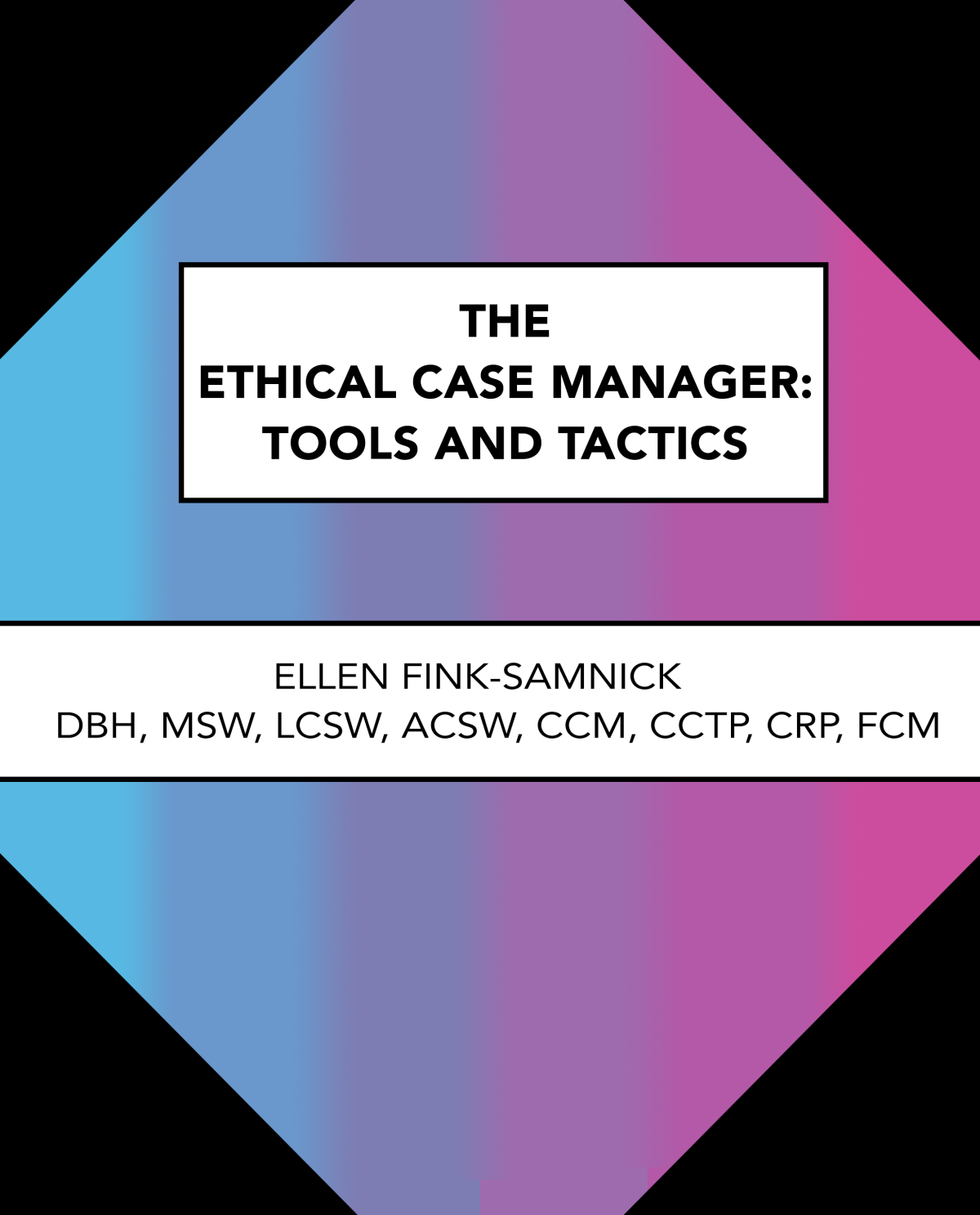
Ethics has long been viewed as not simple black and white, but varied shades of gray. Oh, how the times have changed! Ethics now comprise a spectrum of vivid colors that reflect its fierce disruptions to practice. This reality spans every health and behavioral health professional across every setting. Yet, those in case management face unique struggles. My latest book, The Ethical Case Manager: Tools and Tactics, offers clear guidance.

Unique Workforce Challenges

Case management’s workforce faces challenges not experienced by other professions. First, case management is an umbrella profession comprised of varied professions (e.g., counseling, nursing, occupational therapy, and social work). Each discipline has a distinct code of ethics or professional conduct, as well as dedicated standards of practice. Let’s add another layer of complexity that includes over 25 case management-related credentials for individuals (e.g., ACM, CCM, CDMS, CMGT-BCTM, CRC), organizations (e.g., NCQA, URAC) and their unique requirements. There are assorted professional associations across the industry, which each possess their own standards of practice. The landscape gets more confusing when we include the industry’s hierarchy of case management roles: community health workers, case management assistants, community-based case managers, board-certified case managers, and those in leadership positions. 

The question beckons: Where should your ethical compass point? The range of established resources of guidance defined by each of the above entities makes the answer to this question challenging to answer. It also yields two more confusing conundrums for the workforce:

  1. Defining the ethical and legal parameters for case management practice, and 
  2. Reconciling these parameters with employer policies and procedures across the industry.

The Ethical Case Manager to the Rescue

Here’s where, The Ethical Case Manager: Tools and Tactics comes to the rescueThe book’s content is written for an interprofessional audience that spans the spectrum of degrees held by case managers. This approach provides a context for accountability, while addressing the most complex ethical dilemmas to date.

Focus is on case management job descriptions, outcomes measurement, discharge planning, and care coordination. There’s content on digital healthcare innovation and patient assessment, addressing implicit biases, microaggressions, and health disparities. Promoting the latest domain of health equity, inclusion and belonging is covered, as is workplace bullying, licensure compacts and interstate practice.

Practical facts are blended with Federal and state regulations, tables, templates, and dedicated resources. Each chapter includes case scenarios and critical-thinking review questions for learners to apply the content. 20 Ethical Tactics provide touchpoints for learning. Every reader will reap their own reward, from students, to new and more seasoned case managers, consultants, as well as those in leadership roles.

The Ethical Case Manager’s 318 pages encompass the most vital areas for case managers:

  • Forward by Dr. Colleen Morley
  • Section 1: Essentials of Ethics
  • Chapter 1: Terms and Definitions
  • Chapter 2: Established Resources of Guidance
  • Chapter 3: The Value Proposition
  • Section 2: Realities of Practice
  • Chapter 4: Population-based Practice
  • Chapter 5: Diversity, Equity, Inclusion, and Justice (co-authored with Michael Garrett)
  • Chapter 6: Workplace Bullying
  • Chapter 7: Health Information Technology
  • Chapter 8: Interstate Practice
  • Section 3: Activation of Ethical Decision-Making
  • Chapter 9: Ethical Decision-Making Models
  • Chapter 10: Case Scenarios
  • Epilogue

The Ethical Case Manager: Tools & Tactics will be your primary resource, whether you wish to:

  • Educate students
  • Onboard new staff
  • Benchmark ethical practices
  • Resolve ethical dilemmas
  • Possess timely compliance knowledge
  • Ensure successful fiscal, clinical, and operational outcomes 
  • Use ethical decision-making models
  • Leverage interprofessional teams
  • Inform individual practices

No wonder the book is now on ANCC’s formal list of study references for their Nursing Case Management Exam (CMGT-BCTM)

*************************************************

The Ethical Case Manager: Tools and Tactics is only available on Amazon

Attending these conferences? Special access for attendees to book signing events and giveaways: 

Federal HHS Equity Action Plan Advances Amid New Data on Discrimination by the Health Care Workforce

There’s much to follow on the current health equity radar, from advancement of the HHS’s Equity Action Plan to concerning data validating the high incidence of discrimination by the health workforce toward patients. The onset of stress and vicarious trauma for staff witnessing these events was also identified. Each of these actions will provide pause to even the most seasoned health equity warrior.

The title of this blog article reflects one jam-packed week in our health equity space! There’s much to follow on the health equity radar, from advancement of the Federal Equity Action Plan to concerning data validating the high incidence of discrimination by the health workforce toward patients. The onset of stress and vicarious trauma for staff witnessing these events was also identified. Each of these actions will provide pause to even the most seasoned health equity warrior.

An Equity Action Plan Amplified

The U.S. Department of Health and Human Services (HHS) released a 2023 update to its Federal Equity Action Plan! The plan amplified the commitment of the Biden-Harris Administration to employ its whole-of-government equity agenda that empowers inclusive access to care for all. Many of this blog’s readership are aware of my affinity for wholistic health approaches that encompass physical, behavioral and psychosocial health. Research affirms the validity of these models to ensure successful outcomes for those populations living amid the wholistic health determinants encompassing social determinants of health and mental health, political determinants health, and the systemic racism that perpetuates them.

The HHS Plan outlines five key areas to advance health equity at the macro, meso, and micro practice levels:

  1. Prevent neglect and improve care to help children thrive in their families and communities. 
  2. Promote accessible and welcoming health care for all. 
  3. Improve maternal health outcomes for rural, racial, and ethnic minority communities. 
  4. Prioritize the behavioral health of underserved populations. 
  5. Increase clinical research and trial diversity to support innovation. 

Each of these actions has been the focus of legislation and funding targeting minoritized and marginalized communities. At the Federal level Aligning for Health is a membership association that uses a team of federal and state administration experts to address the mandate for efficient, integrated and coordinated programs that enhance health outcomes for Americans. Their website has an in-time and interactive tracking tool for legislation on health equity and the SDoH. The current 118th Congress is reviewing the following legislation in this space. The current bill count tally is:

  • SDoH Bills; 118
  • Health Equity/Disparity Bills: 36 
  • Maternal and Infant Bills: 0

Since the Equity Action Plan was released in 2022, some progress to address health equity and racial justice has advanced:

  • Proposed rules on language access in all health programs and activities funded by HHS and guidance to states on how to comply with language access and effective communication obligations during and after public health emergencies. 
  • Approved 42 states, DC, and the Virgin Islands to provide 12 months of continuous postpartum coverage through the Centers for Medicare and Medicaid Services (CMS) so that women with low-incomes have stability in coverage.
  • Proposed rules that prohibit discrimination on the basis of disability by updating critical provisions that help persons with disabilities access health and human services under section 504 of the Rehabilitation Act of 1973.
  • Provided practical guidance to HHS offices on identifying actions to ensure opportunity for all.

In addition, The Kaiser Family Foundation (KFF) Medicaid Waiver Tracker shows 63 approved and 37 pending 1115 Waivers in process across the states. For those who haven’t accessed this informative tool, it is a must read. You can also access a current view of the 1115 Waiver landscape by state through the KFF Tracker.

Discrimination by the Workforce: More Norm Than Exception

This action by HHS is especially timely in light of this week’s compelling and concerning research by the Commonwealth Fund on Health Care Workers Observations of Discrimination Against Patients. The report details the perspectives of >3000 members of the interprofessional care team. Discrimination against patients due to race, ethnicity, language and other cultural areas remains widespread, as does the traumatic impact for the workforce itself. Among the most concerning findings include:

Recommendations

Much more work is required to attain the pinnacle of health equity excellence that society deserves. The Commonwealth report lists a series of recommendations to advance actions to mitigate discrimination and ensure psychological and physical safety for patients and the workforce itself:

  • Provide an easy way for patients and health care staff to anonymously report situations involving racism or discrimination. 
  • Examine policies to make sure they result in equitable outcomes
  • Require classes on discrimination at professional schools
  • Create opportunities to listen to patients of color and health care professionals of color
  • Examine treatment of non-English-speaking patients
  • Train health care staff to spot discrimination

I would also add the importance of an ongoing and consistent organizational total quality management approach. This action ensures continuous improvement efforts that are ongoing and sustainable. Addressing health equity, systemic racism, and trauma are NOT one and done.

Professional associations also need to continue their important work to develop advance, and activate strategic health equity deliverables such as implementing revised standards of practice, ethical codes, formal position papers, dedicated tool kits to name a few. 

As I’ve quoted through my health equity and DEIB work on many occasions, “Every patient, their family member, and member of the healthcare workforce should feel safe, seen, heard, and valued.”. The healthcare industry cannot possibly begin to address the health equity equation’s abysmal outcomes without first addressing these levels of oppression, racism, and manifesting trauma faced by for all involved. 

The Interstate Licensure Compact Imperative

Despite interstate practice being more norm than exception, significant obstacles exist for those persons rendering and accessing care. Learn about the current Interstate Compacts and how you can advance them.

What times we are in! Providing clinical intervention and treatment can happen anywhere courtesy of telephonic platforms, plus virtual, remote, and digital products galore. Rural populations rely on these technologies to engage with their practitioners and even health plan case managers, whether for assessment or monitoring of the care process and resource linkage. Patient with disabilities can now access care with greater ease. Yet, there’s a BIG CATCH! Despite interstate practice being more norm than exception, significant obstacles exist for those persons rendering and accessing care.

The health and behavioral health workforce continues to be held hostage by lack of an inappropriate licensure portability structure. Care for consumers is obstructed amid a regulatory system that fails to account for the reality of our professional practice landscape.

Regulatory Realities Reduce Access to Care and Employment

Technology is only one driver of the need for professionals to practice across state lines. Society is more mobile than ever, both for clients and clinicians alike. Traveling practitioners (e.g., case managers, nurses, social workers) are commonly hired to fill employment gaps for staff on medical or family leave, and to mitigate workforce shortages. Yet, this sector of the workforce and their employers face chronic challenges with licensure delays, which only perpetuate barriers and limits to care for the public.

Throngs of licensed mental health providers are at the ready to provide sorely needed telehealth intervention across the states. However, care is often delayed and waiting lists for treatment grow from an antiquated licensure structure that limits one’s inability to practice across state lines. Military families move their state residence every few years and in doing so deal with financial difficulties imposed by licensure delays, and thus, employment. First responders may find their interventions are limited when disasters occur across state lines.

There are an endless list of challenges for the workforce and the public they serve. With minimal exceptions (e.g., licensed professionals who are military members, employed for military contractors), licensed professionals may only practice in the state(s) where they are licensed in good standing. How can licensed practitioners engage with their ethical and legal due diligence when their practice regulations interfere with their ability to do so?

Licensure Compacts on the Move

Licensure compacts are a viable solution for professionals seeking to be licensed in multiple jurisdictions and the that hire them. Through the compact structure, members of the workforce, such as behavioral health providers, case managers, and others who are licensed in one state can actively practice at that same level in other states which are part of the compact. The presence of a compact also reduces the economic burden faced by licensed individuals in dealing with multiple state licensure applications.

The practice of all licensed professionals is controlled by the law in the state(s) where each individual is licensed, typically by the practice act of each state. Scope of practice even supersedes academic degrees. For example, one might presume that as a Doctor of Behavioral Health, I am licensed to prescribe psychopharmacological agents to patients. However, prescribing medications is not included under the scope of practice for my licensure as an LCSW in the Commonwealth of Virginia. The scope of practice for any practitioner extends only to those activities that a person who is licensed to practice as a health professional is permitted to perform.

A change in the traditional licensure structure is mandated: one that allows health and behavioral health professionals to intervene across state and jurisdictional lines. Several professions have engaged in rigorous efforts to advocate for licensure portability through formal regulation.

Nursing

Nurses are required to be licensed in any state where they practice and where the recipient of nursing practice is located at the time service is provided. This fact is a common point of confusion for most licensed professionals—and especially tricky for those my case management colleagues. In contrast, many employers believe licensure must be held in the professional’s state of residence only, instead of where a patient may reside or is receiving care. The Nurse Licensure Compact is actively on the move, and now covers 41 states. More information is accessible on the NCSBN website.

Social Work

The lack of licensure portability has been identified as a public
safety, workforce, and technology issue
. The mandate is clear that the workforce responsible for providing the bulk of mental health services to society must be able to practice across geographic state borders. The formal language for the Social Work Licensure Compact was released in February 2023, with legislation actively being introduced across state legislatures; 24 states have done so at the time of blog post with a current map viewable on the official compact website. 4 states have fully approved the legislation: Missouri, S. Dakota, Utah, and Washington State. The Model Compact Bill must be approved by 7 states to be enacted in its entirety before its necessary infrastructure can be implemented, which is expected to happen in the coming months. After verifying eligibility, individual social workers will then be granted a multistate license, which authorizes their ability to practice in all other compact member states, and removes those longstanding barriers to interstate practice.

Counseling

The American Counseling Association Counseling Compact calls for counselors licensed in one state who have no disciplinary record, to be eligible for licensure in any state or U.S. jurisdiction where they seek residence. Like other disciplines, laws that impact counselors (e.g., mandated reporting statutes) vary from state to state, so the compact recognizes how jurisdictions may require a state jurisprudence exam. At the time of this writing, over 32 states have approved the Counseling Compact with the interactive map viewable on the compact site.

Compacts on the Move

In addition to the compacts listed, further information is available for those covering:

Individual practitioners must engage in advocacy efforts through their respective professional associations. Many of these entities have fierce public policy committees that work diligently to support interstate practice. In addition, contact local legislators to provide individual support for those licensure compacts of interest to you. Access your elected legislators through USA.gov. Remember, support for one interstate compact, leverages them all!

What to find out more on Interstate Compacts, and the Do’s and Don’ts of practice across state lines?? Read Chapter 8 in The Ethical Case Manager: Tools and Tactics, available on Amazon.