Leading the Race for Health Equity: Are IPPS 2023 and CMS’s 2022 Strategic Plan Enough?

“Communities take care of their own”; that is especially true in attaining health equity. Was this grand effort by CMS too little, too late? Industry stakeholders have stepped up to lead the efforts for the population, and are now running far ahead of CMS.

News outlets were flush with reports last weeks of the latest happenings in the Social Determinants of Health (SDoH) space. The top stories were all aligned with press releases from the Centers for Medicare and Medicaid Services (CMS) touting efforts to address “Systemic Inequities” as part of their, 2022 Strategic Plan.

The bold effort encompassed: 

  1. Release of the Inpatient Prospective Payment System 2023 Rule, including the health equity trifecta of:
    • Request for public comment over the next 60 days on means to enhance and/or standardize SDoH documentation through data collection of inpatient claims and metrics that analyze disparities across programs and policies, including a request for information related to homelessness reported by hospitals on Medicare claims
    • Update of the Hospital Readmissions Reduction Program (HRRP) to improve performance for socially at-risk populations, and
    • Implementation of “birthing friendly” hospital designations to improve maternal health outcomes and reduce associated morbidity and mortality. 
  2. Commitment by (CMS) to mitigate health disparities through efforts aligned with Executive Order 13985Advancing Racial Equity and Support for Underserved Communities through the Federal Government.; all CMS offices  are to embed health equity into the core of their work:
    • Aimed to better identify and respond to inequities in health outcomes,
    • Barriers to coverage, and 
    • Access to care.

The means to achieve these efforts included a robust plan that looks great on paper:

  • Close gaps in health care access, quality, and outcomes for underserved populations.
  • Promote culturally and linguistically appropriate services Build on outreach efforts to enroll eligible people across Medicare, Medicaid/CHIP and the Marketplace. 
  • Expand and standardize the collection and use of data, including race, ethnicity, preferred language, sexual orientation, gender identity, disability, income, geography, et al. across CMS programs.
  • Evaluate policies to determine how CMS can support safety net providers 
  • Ensure engagement with and accountability to the communities served by CMS in policy development and program implementation 
  • Incorporate screening for and promote broader access to health-related social needs, including wider adoption of related quality measures, coordination with community-based organizations, and collection of social needs data in standardized formats 
  • Ensure CMS programs serve as a model and catalyst to advance health equity through our nation’s health care system, including with states, providers, plans, and other stakeholders.
  • Promote the highest quality outcomes and safest care for all people using the framework under the CMS National Quality Strategy.

Yet, my antennae shot up while reading one CMS quote:

“ The agency will bring together healthcare stakeholders—including payers—to promote implementing a health equity strategy. The first meeting will address achieving health equity in maternal healthcare, specifically. It will occur during the summer of 2022.”

Time to hurry up and wait. It seems the health equity strategy is not totally defined: shocking, I know! My elation at seeing formal acknowledgement and attention to, systemic inequities, was quickly dashed. Advancing legislation and funding for the SDoH alone will not fully mitigate the gaps in care. Most experts agree these well-intended efforts will fail, unless the systemic biases that have created and perpetuated the SDoH are also addressed. 

CMS will have to do better than introducing a health equity pillar with strategic language. On the other hand:

  • YES, for the $226.5 M announced this week via HHS and HRSA for Community Health Worker training; build that segment of the workforce. The fiscal and clinical impact of CHWs is massive, enhancing discharge planning outcomesenhancing treatment and resource access to the most at-risk patients and populations, which bridges serious gaps in care.
  • Develop, fund, and maintain the data exchange infrastructure: 
    • Expand and implement more end to end, social risk analytics and assessment programs like those in play by UniteUsSocially Determined., and 3M.
    • Expand ICD-10 CM Z codes and approve their reimbursement. I cloud the issue with logic, though reimbursing organizations for the blatant impact of the SDoH and MH on healthcare utilization (e.g., length of stay, ED admissions, readmissions, costs) would greatly enhance revenue coding and capture by healthcare organizations. Organizations will use the codes if there is direct fiscal incentive to do so. GO GRAVITY PROJECT !
    • Grow technology programs that directly support my hospital case management colleagues in assessing, referring, and directly connective patients to needed resources, such as FindHelp.
  • Expand, Food is Medicine programs nationwide, along with the means to assess and directly link patients to necessary nutritional resources GO FarmBoxRx, FoodSmart!
  • Grow funding to Community-based organizations, and safety-net programs, as in community action agencies, neighborhood health clinics, and federally qualified health centers: these are the folks in the trenches!

There was a time when, where CMS went (in terms of reimbursement, programming, and funding) the rest of the industry followed. Yet has this trend shifted? Many have heard me say, “Communities take care of their own”; that is especially true in attaining health equity. Was this latest effort by CMS enough? In time, outcomes will tell the story, but for now, industry stakeholders have stepped up to lead the efforts for their communities, and running ahead of pack.

Your comments are valued so feel free to add them below. 

The Dismal State of Maternal Wholistic Health for Women of Color

Change is long overdue for this massive maternal health chasm of wholistic health disparities, transcending physical, behavioral, and psychosocial health, and particularly for women of color (WOC)

April 11-17th marks annual Black Maternal Health Week. There will most likely be a flurry of well-intended articles, blog posts and announcements focused on legislation, funding of initiatives and programs, and advocacy. But here’s the lowdown: Black mothers have had higher mortality than White mothers for well over 100 years. They are > 3X more likely to die from pregnancy-related complications and 2X as likely to suffer from mental health issues than their White counterparts. The impact of historical, intergenerational, medical, racial trauma is invasive and enduring. Change is long overdue for this massive maternal health chasm of wholistic health disparities, transcending physical, behavioral, and psychosocial health, and particularly for women of color (WOC)

The recent Commonwealth Fund report on women’s reproductive health reveals how severe the issue remains:

  • U.S. women have the highest rate of maternal deaths among high-income countries. The current maternal mortality ratio of 17.4 per 100,000 pregnancies, equals roughly 660 maternal deaths. This earns the U.S. last place standing overall among all industrialized countries.
  • A woman’s chance of dying in southern states is 2X greater than those in the north:
    • Alabama, Arkansas, Kentucky, and Oklahoma report death ratios of greater than 30:100,000 live births 
    • California, Illinois, Ohio, and Pennsylvania reported death ratios less than half the figures in those states, <15 deaths: 100,000 live births

Data for WOC is beyond alarming: 

  • The maternal death ratio for Black women is 37.1:100,000 pregnancies. The number is 2.5X the ratio for white women (14.7) and three times the ratio for Hispanic women (11.8).
  • Hispanic mothers were 80% as likely to receive late or no prenatal care as compared to non-Hispanic white mothers.
  • Black mother with a college education is at 60% greater risk for a maternal death than a White or Hispanic woman with less than a high school education.
  • Even when WOC verbalize health and mental health concerns to providers, their voice is disregarded:
    • WOC are more likely than White women to express their concerns and preferences regarding births though more frequently ignored
    • Women with Medicaid report inadequate postpartum care and support, where they are:
      • Pressured to have C-sections
      • Not scheduled for postpartum visits
      • Disrespected by providers due to insurance
  • Pregnancy-related mortality rates vary across ethnic groups, yet show a constant disturbing trend:
    • Black (40.8%), American Indian/Alaska Native (29.7%), Asian Pacific Islander (13.5%), and Hispanic (11.5%) compared to Whites (12.7%).
    • Upwards of 60% of these deaths are preventable. A CDC report, reveals the often avoidable causes:
      • Infection (13%)
      • Postpartum bleeding (11%)
      • Cardiovascular conditions such as Cardiomyopathy (11%), 
      • Blood clots (9%), 
      • High blood pressure (8%), 
      • Stroke (7%), and a category combining other cardiac conditions (15%). 

Maternal Mental Health Awareness Week is scheduled annually for the first week in May, though bears mention. Not treating maternal mental health conditions costs $32,000 per mother-infant pair, totaling $14.2 billion nationally

  • Black women are twice as likely as Whites to suffer from perinatal mood and anxiety disorders, and less likely to receive treatment: 40% compared to 20-25%  
  • Indigenous women have a higher incidence of depression, anxiety, and substance misuse during the perinatal period from 17-47%; Indigenous identity increased the likelihood by 62%
  • Migrant WOC are at greater risk for behavioral health issues during pregnancies (e.g., depression, schizophrenia, post-traumatic stress) from the interaction of psychosocial determinants as forced migration plus generalized insecurity associated with experiences as refugees, asylum seekers, and human trafficking victims

Endless data validates WOC’s maternal health mandates. Recent years have witnessed robust action courtesy of fierce voices and tireless work of many entities in the US and around the globe. Their agendas serve as a clearinghouse of efforts. The list below is a starting point of resources:

The “honorary” annual week is valued, but a wholistic health crisis of this magnitude mandates far more than 7 days of attention. Distinct legislation, dedicated and substantial funding at federal, state and local levels is vital. Yet, these efforts are for naught unless the systemic racism and implicit bias that perpetuate this reality are equally addressed. We must:

  • Identify, call out, and dismantle systemic racism across macro, meso, and micro spaces
  • Develop and implement population-inclusive clinical predictive analytics and algorithms
  • Ensure dedicated quality metrics that report the necessary outcomes to drive clinical programming, treatment, and concordant practices
  • Shift the academic curriculum to better prepare the interprofessional workforce to provide population-specific care without bias
  • Continue to advance the concordant provider-base
  • Expand ethnic, racial, and cultural programming, such as reimbursement of community-based Doulas, especially in medically underserved areas.
  • Expand access to fertility treatments and address racial disparities in outcomes for IVF. Black women are more likely to have infertility compared to other races, yet the access to treatment is minimal

Data has long validated this epidemic’s emergent state, which has continued to escalate. Maternal wholistic health is a public health emergency of the highest priority. This article is just the tip of the iceberg. I invite those in this care space to post additional resources and information.

What Good Is Health Plan Cost-Sharing When Persons Can’t Afford to Access Care?

Increasing numbers of persons challenged by cost-sharing options only adds to the growing tally of persons struggling with social determinants of health and mental health; this counters efforts to attain wholistic health equity.

Outcomes
Researchers analyzed data from the 2019 Survey of Consumer Finances with telling results:
• High percentages of non-elderly households lack sufficient assets to meet typical plan cost-sharing amounts.
-45% of single-person non-elderly households unable to pay average cost-sharing amounts of $2,000 annually; low income households were in the same boat
-63% could not pay over the higher plan amounts of $6,000.
• Available liquid assets for single-person non-elderly households with incomes <150% of the federal poverty level (FPL) were limited; available assets averaged $577 vs $1,753 for those between 150% and 400% of FPL, and $13,243 for those above 400% of FPL.
• Median available liquid assets among multi-person households were $698 for those below 150% of poverty compared to $2,996 for households between 150% and 400% of poverty, and $23,439 for households with incomes of 400% of poverty or more.
• 84% of multi-person households with incomes <150% of the FPL lack $4,000 in liquid assets
• 50% of households could not afford a basic employer insurance plan deductible ($2000)
• 2:3 households lacked funds to covered a high-end deductible ( $6000)

Deductibles, co-pays, co-insurance are common means of health plan cost-sharing. However, what happens when healthcare consumers are unable to pay them? A recent study by the Kaiser Family Foundation revealed the sorry truth: health plan enrollees are too often unable to access the care they need, or forced into medical debt and bankruptcy to do so. In a time when strong efforts are in play to bridge healthcare disparities and ease access to care, that reality remains an elusive butterfly for too many individuals.

Most households lack sufficient liquid assets to meet an out-of-pocket maximum. Some might recall that the Affordable Care Act limited out-of-pocket maximums for most private health insurance plans: $8700 for single coverage, $17,400 for family coverage. This is appalling considering the Affordable Care Act set out-of-pocket minimums, yet the average out-of-pocket maximum for single coverage in 2021 was $4272.

Rising Medical Debt
Amid the pandemic, high numbers of persons faced emergency medical bills from care, whether related to COVID-related costs, or deferred health and behavioral issues. Roughly 62% of households with incomes between 150% and 400% of the poverty level were unable to afford care or access the approximately $3000 needed to cover urgent care costs.

Recent reports show dismal results for persons dealing with psychosocial challenges, as well as rising medical debt:
• >50% of Americans experience medical debt
• >57% owed over $1000
• 40% had problems paying medical bills or affording premiums
• 65% who earned <$40,000 and 51% earning $40,000 to $75,000 could not afford premiums despite having employer-sponsored coverage.

• >51% of persons with employer-sponsored plans reported someone in their household delayed or skipped care, or filling a prescription due to the associated expense
• 26% of adults with an employer-sponsored plan had to cut spending on food, clothes, or other household items to pay their health-related expenses.
• 20% took on an additional credit card debt to pay their expenses

The rising numbers of persons challenged by cost-sharing options must be resolved. This reality only adds to the growing tally of persons struggling with social determinants of health and mental health, countering efforts to attain health equity. More must be done to enhance access to care for every person across the wholistic health landscape of physical, behavioral, and psychosocial health.

The Impact of Trauma and Systemic Racism on Wholistic Health Equity

Abundant data on wholistic health disparities mandates intentional, sustainable quality improvement action. Will the next generation of metrics account for this reality?

There is an industry priority to right the societal wrongs associated with historical trauma and systematic racism. These long-standing realities are key drivers of wholistic health disparities: physical, behavioral, and psychosocial health.. A fluid stream of outcomes mandate concordant approaches to racial, ethnic, and other cultural contexts of treatment (e.g., disability, familial choice, gender orientation, regional influences). Yet, despite research to validate data wholistic health outcomes, reflective quality metrics have not been developed.

What Are We Talking About?

            Abundant data assesses the impact of historical, racial, and other types of trauma on health and behavioral health outcomes. Increased healthcare utilization has been identified for survivors of physical and sexual trauma, primarily minority women. Campbell et al. (2002) studied 2,355 females, 21-25 years old, enrolled in a large health maintenance organization (HMO). Patients who experienced intimate partner violence had a far higher prevalence (>50%-70%) of gynecological and central nervous system complaints (e.g., back and pelvic pain, fainting, headaches, seizures), plus other stress-related health issues (e.g., hypertension, insomnia, susceptibility to viral/bacterial infections). Purkey et al. (2020)identified trauma survivors as frequent users of primary, urgent, and emergency care for acute and chronic symptoms. Clarke et al., (2019) discussed the presence of vague somatic complaints by patients who endured traumatic experiences (e.g., ACEs, bulling, pressures to excel in school and career). Costly emergency department visits and ambulatory diagnostic tests are frequently used to identify etiology for chronic and diffuse pain, digestive problems, headaches accompanied chronic illness exacerbation, yet to no avail.    

Another vital dyad for attention involves chronic pain management and stigma experienced by patients from marginalized communities. Wallace et al. (2021) completed a recent study; participants were trauma survivors (e.g., historical, racial, sexual) and members of indigenous, LGBTQIA+, or refugee communities. The results were telling. When physical and emotional pain were expressed to providers, they was minimized or dismissed. If acknowledged by providers, short-term prescriptions were given versus referrals to behavioral health and other specialists.

What Does it Imply?

Data mandates the need for intentional, sustainable quality improvement in this arena. Will the next generation of metrics account for this reality? Racism remains a major factor to drive racial and ethnic inequities in health and mental health, though fails to be addressed in healthcare’s quality proposition. Of the articles reviewed for this blog post, trauma-informed quality analysis of care remained elusive. 2021 saw a fresh generation of industry health equity measures, yet few addressed integrated care, let alone assesses wholistic health equity. Existing metrics continue to silo health or behavioral health. Insufficient focus has been on industry-vetted quality models addressing population-focused, concordant, trauma and equity-focused interventions. 

Where Will Health Equity’s Quality Compass Point?

This author is developing a Quintile Aim for consideration, which adds the pivotal domain of Wholistic Health Equity to the industry’s seminal quality compass. NCQA continues to push this agenda in evolving new metrics. Public comment is open (until 3/11/22) for new HEDIS measures targeting the SDoH. Wyatt et al. (2016) posed a 5-step quality model for organizations to advance health equity delivery to the communities they served, addressed in Figure 1. 

Figure 1: A Framework for Healthcare Organizations to Achieve Health Equity (Wyatt et al., 2016) 

Wyatt R, Laderman M, Botwinick L, Mate K, Whittington J (2016). Achieving Health Equity: A Guide for Health Care Organizations. IHI White Paper: Institute for Healthcare Improvement 

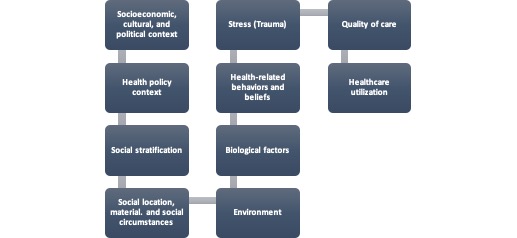
The model was well-intended though had limited substance or strategic action to leverage the intent. This effort was reminiscent of the Quadruple Aim; little data drove the model and obstructed full industry acceptance. By contrast, Dover and Belon’s (2019) Health Equity Measurement Framework (HEMF) is worthy of exploration. Based on the World Health Organization’s Social Determinants of Health model, HEMF vast evaluation areas to measure health equity at macro, meso, and micro levels, as shown in Figure 2. 

Figure 2: HEMF Framework Elements (Dover & Belon, 2019)

Dover, D.C. and Belon, A.P.  (2019. The health equity measurement framework: a comprehensive model to measure social inequities in health. Int J Equity Health 18,36 https://doi.org/10.1186/s12939-019-0935-0

The HEMF model is worthy of a test drive to gauge its true merit. Use of the wide-scope of theoretical and evidence-based industry elements is an asset. Population diversity and complexity are accounted for through power-related and disparity measures. Health beliefs, behaviors, and values are acknowledged with stress factored in; the traumatic-response across circumstances is embedded. My desire to keep this post brief limits further elaboration on the HEMF model. However, know it poses strong value as a robust quality model to address health, behavioral, and racial health disparities across populations exposed to trauma’s diverse lens.  

Have other integrated care quality models that account for wholistic health equity? Add your considerations and comments below!

Are Safety Net Programs Losing Their Safety Net?

A far bigger safety net must be in place to support these essential facilities, programs, providers, and the communities who rely on them. More must be done quickly to ensure safety net sustainability.

The nation’s 56 official safety nets strive to provide quality health and mental health to the nation’s most in need populations. Yet, new struggles to do so are endangering the lives of patients and mandate swift action.

Safety Net Realities 

A quilt of >14,000 sites comprise the safety net system: disproportionate share hospitals, federally qualified health centers (FQHCs), rural, and community health centers. Location maps and listings are accessible at HRSA’s FQHC with a safety net hospital list at their trade association website (America’s Essential Hospitals). These sites provide care:

  • Independent of patient ability to pay and immigration status
  • To the highest share of Medicaid and uninsured patients: 75% and 60% of the population respectively!
  • Across rural and urban regions and both, public and non-profit entities 

Pandemic-related financial headaches continue for the industry, safety net hospitals shouldering more than their share of this burden. Rural regions have seen a waning hospital presence, adding pressure to remaining FQHCs. The Sheps Center displays >100 closures in the past decade50% of 2020 closures for safety net facilities alone.

A recent Kaiser Family Foundation issue brief reviewed COVID’s disproportionate impact on populations covered by Medicaid and Medicare, including people of color and those who use long-term services and supports. Providers serving these patients were less likely to have received monies from the $178 B in pandemic federal provider relief funds; barely $13.1B went to safety net hospitals with a mere $11B to rural providers. This reality contributes to national health expenditures soaring to $4.1 Trillion dollars. The amount accounts for early 2020 through the pandemic’s first wave, which hit safety net facilities hard. Pandemic-related losses for the largest safety net hospitals (e.g., 1000 beds) are as high as 50% of their quarterly revenue. 

Loss of 340B Drug Discounts

Recent loss of 340B drug discounts has meant major fiscal challenges for safety-net programs. The legal battle against drug makers wages in the courts. HRSA has stepped up, imposing fines against drug makers when possible. A study of 510 urban facilities identified losses at 23% of savings from due to loss of 340B, a median of $1 M. Critical access hospitals saw 40% of savings lost, roughly $220,000. While that amount seems small, it is a major hit to these rural hospitals with a max of 25 beds, located 10 miles from other providers. While dollars and losses are relative to each organization, the bottom line is the same; patient endangerment from cuts and closures of needed programs, potentially the only facility or service provider for miles.

How to Save the Safety Nets

7 ideas are posed by experts to strengthen the safety-net foundation: 

  1. Increase federal funding: Target funds to hospitals that qualify for Medicaid disproportionate-share hospital (DSH) payments. Use hospital census data to more equitably distribute payments to facilities that primarily treat uninsured and Medicaid patients (and not Medicare patients). 
  2. Clear Guidance: Federal agencies, as the CDC should use hospital census data to more equitably distribute payments to facilities primarily treating uninsured and Medicaid patients. This action is a sound public health reimbursement strategy moving forward. 
  3. Streamline Regulation: Reduce regulatory burdens to foster reimbursement, such as ongoing expansion of telehealth and virtual requirements and reimbursement, lengthen quality reporting programs, and extend leniency with value-based purchasing programs. These will help hospitals to recover financially from pandemic-related losses.
  4. Loan Forgiveness: Expand programs that incentivize new clinicians to accept positions in safety-net programs. This action will bolster the workforce of providers who accept new Medicaid patients.
  5. Expand Coverage Options: Advance these options to limit growth of uninsured patients and uncompensated care
  6. State And Local Initiatives: Enact policies to mitigate effects of hospital closures. Keep public and surrounding healthcare systems informed so regions can best plan for, and provide necessary outreach to service shortage areas. This will also minimize service gaps, providing safer transitions of care.
  7. Community and Volunteer Efforts: Target corporate and community investing to bridge gaps in care: create grants, fundraising campaigns, horizontal mergers, to build satellite clinics, services, and programs. 

A far bigger safety net must be in place to support these essential facilities, programs, providers, and the communities who rely on them. More must be done quickly to ensure safety net sustainability.

I know there will be other suggestions, so add them in the comment area below.

#safetynet #accesstocare #bridgethosegaps #340B #funding #interprofessionalimpact #interprofessional insights 

Follow Ellen’s Interprofessional Insights to stay, in the know with the State of the SDoH & MH

5 Ways to Use SDoH and MH Data to Advance Your Advocacy

All that health disparities data gets overwhelming. Here are distinct ways to use and leverage the data to your advantage

What don’t the SDOH and MH impact?

This last few weeks has seen the usual litany of published research on how the social determinants of health and mental health (SDoH & MH) impact health and mental health outcomes. All denote significant care disparities across disease states and populations, including but not limited to the following embedded studies:

I’m a research nerd; my colleagues, mentees, and students are most likely breaking into big smiles about now. If there is relevant literature on a topic, I’ll find it. While I’m not a researcher, I will use any metrics and outcomes to craft sustainable solutions, and motivate others to do so. 

Data is Overwhelming, BUT

Many persons share their frustration with me about the abundance of SDoH & MH data. It can feel like the massive data speaks to a worsening state of affairs. However, the data is meaningful; you can’t fix what you don’t know! Remember, each piece of literature provides vital validation for necessary legislation, funding, and reimbursement to bridge those identified gaps in care. Here are 5 ways to use the data to advance your SDoH & MH advocacy:

  1. Stay current on relevant legislation: A flurry of federal and state legislation is on the horizon, all driven by dedicated research. My friends at Aligning for Health maintain an updated roster of SDoH legislation on their site that can be accessed here; current heavyweights include the Social Determinants Accelerator Act of 2021 and Leveraging Integrated Networks to Communities (LINC) to Address Social Needs ActI’d encourage those interested to sign up for weekly bi-weekly notifications on these, and other laws.
  2. Follow the Funding: Dollars are available to build services and programs that bridge health equity gaps.
  3. Join relevant advocacy efforts: Along with RISE Association and Aligning for Health mentioned above, Root Cause Coalition is a national group of organizations committed to reverse and end systematic wholistic health inequities. 
  4. Prioritize the data important to you!: That research churns fast and furiously; follow and sign up for notifications from sites and entities covering the SDoH & MH that matter to you and your organization. This may be research from JAMA or LancetHealth Affairs, Brookings Institute, Hastings Center, or the CDC. This recent issue brief from the Kaiser Family Foundation hones in on current pandemic priorities; scroll down to a stellar graphic detailing the wholistic health landscape. The Satcher Institute has updated their Health Equity Tracker with SDoH and PDoH (political determinants of health) by state; they’ve also added behavioral health to the mix!
  5. Sign up for notifications from those, in the know: That inbox gets busy, so take charge by signing up for notifications from key players in the SDoH space. If you liked this blog post, click on the, Follow Ellen’s Interprofessional Insights button in the sidebar of this page to receive my bi-weekly blog and vital health equity information.

I look forward to your comments on this blog post, and other strategies you use to keep your finger on the pulse of wholistic health equity priorities. 

#SDoH #SDoMH #Healthequity #funding #interprofessionalimpact #accesstocare #bridgethosegaps