ERCI’s 2025 Top 10 Patient Safety Issues and Heeding Case Management’s Professional Obligations

ERCI’s 2025 safety issues represent a clear and present danger for patients with opportunities for all healthcare professionals. Yet, these quality missteps also yield concern for how case managers understand their professional obligations to the practice principles that underlie our licensure, certification, and organizational accreditation. 

I am a quality warrior! This fact means that my brain goes into overdrive when certain reports cross my radar.  The latest intel to have this impact was ERCI’s 2025 list of Patient Safety Threats. My focus immediately focused on the #1 issue, “Dismissal of the Patient and Caregiver Voice”. As a social worker by education and licensure and board-certified professional case manager, I am responsible for mitigating this quality gap. I also happen to be a fierce industry disruptor courtesy of my Doctorate in Behavioral Health. My DBH colleagues and students will get this one,  but I digress. 

I am an enduring ethical, legal, and regulatory champion to my core. I have been digging deep into the research, writing about, and presenting on medical gaslighting and invalidation for the past year. The dismissal and devaluing of any patient and caregiver voice is clearly associated with this obstructor to care. Medical gaslighting’s connection to increased costs of care is significant with billions of dollars lost from delayed and missed diagnoses. Increased healthcare utilization has come from unnecessary hospitalizations, readmissions, treatment missteps, yielding poor health outcomes. Mortality rates are equally higher when a patient’s voice or that of their caregiver is ignored.

Yet, two other areas of concern stood out to me as I reviewed the list of other patient safety priorities on the ERCI list:

  • #5. Caring for Veterans in non-military health settings
  • #9. Inadequate coordination during patient discharge

These two issues speak loudly to all of my colleagues, but particularly those in my professional case management world.

Professional Obligations Matter

Colleagues frequently ask me, why I get so hot about our established resources of guidance (e.g., accreditation and credentialing requirements, standards of practice, codes of ethics) ”. Yes, the hashtag or #EthicsMatter has become my hallmark. However, the list of 2025 safety issues represent a clear and present danger for patients. Quality missteps and patient safety concerns mean case managers are not heeding their professional obligations to the practice principles that underlie our licensure, certification, and organizational accreditation. This action represents potential professional sanctions for breach of the very requirements that bolster our case management profession. 

Standards of Practice

Those professionals who walk in the world of case management are accountable to assorted standards of practice and codes of professional conduct. The Case Management Society of America (CMSA) set the tone for these seminal documents, crafting the initial version in 1995. Updating of each version of the standards occurs through a formal vetting process that was completed in 2002, 2010, 2016, and 2022. The addition of Standard Q: DEIB and Health Equity yielded a revised version of the document in 2024. 

The intent of the standards are simple: to “serve as a compass for all who practice case management. They stand as a blueprint for excellence in practice”. They are not meant to be prescriptive in intent. Instead, they serve as a guide for professional case managers and their organizations to define optimal practices for the industry that meet ethical, legal, and regulatory guidelines and requirements. The relevant standards of practice by CMSA that address these patient safety realities include: 

D. Ethics

E. Advocacy

G. Resource management

I. Client selection

J. Client assessment

K. Identification of care needs and opportunities

L. Planning

M. Facilitation, coordination, and collaboration

N. Monitoring

O. Outcomes

P. Closure of professional case management services

Q. DEIB and health equity

Each standard details clear guidance for the workforce in each of these critical areas of case management practice. 

Licensure and Certification Requirements

Case managers have a primary responsibility to the licensure and scope of practice that underlies their professional discipline, whether in counseling, medicine, nursing, occupational, physical, respiratory or vocational therapy, social work or other qualified disciplines to practice (CMSA Standard A. Qualifications).  Yet, we are then responsible to our case management credentialing, which is often dependent on this primary licensure. 

Our credentialing entities prioritize the importance of critical competencies for their certificants through dedicated resources. The Code of Professional Conduct for Case Managers authored by The Commission for Case Manager Certification (CCMC) details keenly defined ethical standards, rules, procedures, and penalties for the workforce. The document’s Preamble sets a critical tone by defining case management as “a professional, collaborative, and interdisciplinary practice guided by the Code of Professional Conduct (the Code)”. The resource goes on to further denote the main purpose of the code; “to protect the public”. While the guidelines provided are advisory in nature, they still set a professional standard to which all board-certified case managers are held accountable.

The American Case Management Association (ACMA)’s Scope of Services and Standards of Practice also define clear competencies for practice. This resource also aligns with the association’s Accredited Case Managers Credentialing Exams, which have oversight by the National Board for Case Management:

Relevant Scope of Services, including but not limited to::

  • Assessment
  • Care coordination
  • Facilitation
  • Transition management  competencies 
  • Longitudinal care management
  • Identification
  • Implementation

Relevant Standards of Practice, including but not limited to:

  • Accountability
  • Advocacy
  • Resource management

Organizational Case Management Accreditation

Attention is also paid to these critical domains of practice by each of the entities that are tasked with providing, regulating, and monitoring of organizational case management accreditation. These include NCQAURAC, and ANCC’s Magnet Recognition Program. The agencies define strict compliance requirements and standards for case management practice, as well as for the entities by which they recognize certification through. 

The workforce should remain aware of the following: 

Note: As of January 1, 2024, Magnet Status Recognition only accepts certifications accredited by the Accreditation Board for Specialty Nursing Certification (ABSNC) or the National Commission Certifying Agencies (NCCA). Included are  ANCC’s Nursing Case Management board certification (CMGT-BC) and the Commission for Case Management Certification’s Board-Certified Case Management Credential (CCM).

The Bottom Line

Case managers have a critical role in ensuring compliance with the ethical, legal, and regulatory  standards and requirements that underlie our practice. Each one of the established resources of guidance for case management prioritize our professional obligations to advocate for, monitor, and ensure patient safety; public protection remain a priority. They also heed every case manager’s accountability to the industry’s Quality North Star of the Quintuple Aim: patient- and family-centric care rendered at the right time, for the right cost, by professionals who embrace the work, and delivered in a way that is equitable and accessible for all.

ERCI’s Top 10 Patient Safety List for 2025 should be a call to action by every healthcare organization with attention from every case management leader and their teams. How will you and your organization step up to mitigate these gaps in quality and care? 

Tackling Workplace Bullying and Promoting Psychological Safety

October is National Workplace Bullying Awareness Month. The incidence of bullying within healthcare continues to rise, and with dangerous consequences for patients, as well as the workforce itself. Identify workplace bullying’s newest dimensions and learn how to promote your psychological safety.

October is National Bullying Awareness Month. Every year I hope for improvement in the landscape of this fierce disruptor, and especially for my colleagues within healthcare. Yet, the incidence of incivility keeps rising. The post-pandemic disruption continues with workforce shortages, attrition and retention challenges, staff burnout, and a slew of occupational hazards. What began decades ago with a few posturing practitioners and nurses who ate their young remains an interprofessional sport that every discipline plays, and nobody gets to sit out.

Psychological Safety and Workplace Bullying

Bullies take chronic hits at your psychological safety. Their goal is to make you feel inefficient, ineffective, and incapable of performing your role. They mess with your perception of whether it is safe to take interpersonal risks within your appointed role at work, such as in taking initiative to advocated for patient care and treatment. They sabotage your sense of self and thus confidence so that you may fail to follow through on critical communications with team members. Ultimately, the quality of your workplace performance is questioned along with your mental health.

Bullies are ever-present across sectors and can invade your volunteer experiences, such as roles for a professional association or other efforts. An activity you engaged in for sheer enjoyment, becomes as arduous to engage in as any professional role. Ultimately your occupational health, mental health, and safety are all compromised. Every member of healthcare’s valued interprofessional workforce is impacted:

Bullying and incivility incidence have ramped up from DEIB’s lens, and impacting:

Negative outcomes are plaguing quality improvement and risk management specialists across practice settings. Incivility by practitioners leads to medical errors >75% of the time, and resulting in death >30% of the time. The workforce is also at elevated risk of trauma, and especially suicide from repeated psychological assaults:

  • Suicidal ideation: >30% of victims (of bullying) 
  • Suicide: Victims 2X as likely to take their own life compared to those not exposed

Bullying’s Advancing Dimensions

Bullying is a consistent pattern of repeated, health-harming mistreatment of one or more members of the workforce, marked by abusive conduct that is threatening, humiliating, or intimidating. Work is delayed, sabotaged, and obstructed. These are impediments that NO professional can afford in the fast-paced industry. We’re not talking about random episodes when someone feels crispy around the edges or has a bad day, but rather a chronic and recurrent pattern of behaviors that somehow devalues others.

Gaslighting, Mobbing, and Remote Bullying, OH MY!

Bullying has morphed into assorted dimensions. Gaslighting occurs when a colleague ignites the gas by tossing out an inflammatory implication that forces you or others to question your actions or ability to do the job. The bully fans the fire by ongoing attacks; they may challenge your memory of events, such as implying that you ‘forgot’ to follow up on dialogues with a patient’s family or member of the care team. There may be comments to other colleagues about your bouts of ‘memory loss’. Imagine, being approached by staff or patient families to verify if you completed documentation that you clearly recall doing. Even you start to question the quality of your work performance, especially as your reputation and job performance are at issue. Six types of gaslighting are:

  • Countering: Challenging someone’s memory 
  • Denial: Refusal to take responsibility for actions
  • Diverting: Changing a discussion focus by questioning someone else’s credibility 
  • Stereotyping: Generalizing through negative or discriminatory views of a person’s race, ethnicity, sexuality, nationality, or other cultural nuance. 
  • Trivializing: Disregarding when someone feels minimized by what is said and devaluing the impact
  • Withholding: A bully pretends to not understand a conversation and refuses to listen to another person’s view. That person ends up doubting themself. 

Mobbing is bullying on steroids and occurs when multiple staff target one or more personnel. Almost 50% all bullying incidents involve mobbing with 54% of primary care professionals exposed to this type of incivility on at least one occasion. Perhaps, a new director of Case Management at an MCO changes the job description to require all new hires to possess case management certification; current employees must be certified by the end of that calendar year. Staff view this requirement as an undue hardship and become frustrated. The rumor mill ensues: ‘The quality of the work isn’t important, only if we can pass a test.’; ‘she doesn’t care about us.’ The mob works to discredit the boss and push her out the door. Staff may view a new colleague as not fitting in, whether because of being in a different age group, professional discipline, as well as race, ethnicity, gender, sexual orientation or other cultural nuance. As a result the staff member does not feel safe, seen, heard, or valued.

Remote bullying has risen amid the increase of virtual roles. Some 43% of employees were exposed to remote bullying experiences:

  • 50% of incidents during virtual meetings
  • 10% via email interactions, and 
  • 6% during group emails and chats. 

What YOU Can Do to Promote Psychological Safety!
Bullies are insidious and invasive in their efforts. BUT, here’s their dirty secret and biggest misstep! BULLIES target the most ethical, hard-working, and high-performing individuals in an organization. If you’ve been bullied, it means you’re more powerful than you’ve ever imagined, as you’re a threat to the bully and their ineptitude.

Tackling bullying involves strategy:

  • Intervene early: Don’t let a precedent be set and address the behavior directly
  • Don’t react to the bully: ‘Take 10’ to breathe, consider, and define an approach
  • Document each incident: Date, time, witnesses, and who you discussed it with.
  • Don’t let the bully isolate you: Keep engaged with peers and those who trust your savvy.
  • Set limits on negative behaviors you will allow: We may let small things go, but stay vigilant.
  • Don’t share lots of personal details at work: This info will be used against you
  • Take time to recharge from incidents: Mental health days or vaca help restore your resilience
  • Seek Support: Peer support and mental health support are MUSTS; one may potentially need independent legal support!
  • Put your best professional self forward: Bullies thrive on the weakness of others, so keep showing that best version of yourself  
  • Approach bullying as a work project: Being methodical keeps you in control. Assess  financial costs of staff departures related to bullying, and the ROI of psychological safety and other workforce retention strategies

Those steps and other ways to advance each above strategy live in Chapters 3 and 6 of The Ethical Case Manager: Tools and Tactics. The book’s content:

  1. Defines terms associated with workplace bullying
  2. Discusses how workplace bullying impacts physical and mental health 
  3. Aligns workplace bullying, quality of care, and patient safety 
  4. Recognizes the “Bullying Recipe” within organizations
  5. Examines how the practice culture of professional education impacts incidence
  6. Explores the incidence across the DEIB landscape 
  7. Identifies types of organizational culture that contradict workplace bullying
  8. Discusses leadership styles to impact workplace bullying in organizations
  9. Identifies legislation and professional initiatives to combat workplace bullying
  10. Explores how bullying impedes the ethical performance of case managers 
  11. Offers quality monitoring tools to address unprofessional behaviors
  12. Informs you how to calculate costs of workplace bullying for your organization 

REMEMBER

Keep Ellen’s Ethical Mantras close by:

  • We deserve respect.
  • We deserve to feel safe. 
  • We deserve not to feel trapped in a toxic workplace.
  • We deserve to have our knowledge and expertise valued.
  • We deserve to have confidence that all are accountable for their actions.
  • We deserve to be able to confront workplace bullying without fear of retribution.

October is National Bullying Awareness Month. Every year I hope for improvement in the landscape of this fierce disruptor, and especially for my colleagues within healthcare. Yet, the incidence of incivility keeps rising. The post-pandemic disruption continues with workforce shortages, attrition and retention challenges, staff burnout, and a slew of occupational hazards. What began decades ago with a few posturing practitioners and nurses who ate their young remains an interprofessional sport that every discipline plays, and nobody gets to sit out.

Psychological Safety and Workplace Bullying

Bullies take chronic hits at your psychological safety. Their goal is to make you feel inefficient, ineffective, and incapable of performing your role. They mess with your perception of whether it is safe to take interpersonal risks within your appointed role at work, such as in taking initiative to advocated for patient care and treatment. They sabotage your sense of self and thus confidence so that you may fail to follow through on critical communications with team members. Ultimately, the quality of your workplace performance is questioned along with your mental health.

Bullies are ever-present across sectors and can invade your volunteer experiences, such as roles for a professional association or other efforts. An activity you engaged in for sheer enjoyment, becomes as arduous to engage in as any professional role. Ultimately your occupational health, mental health, and safety are all compromised. Every member of healthcare’s valued interprofessional workforce is impacted:

Bullying and incivility incidence have ramped up from DEIB’s lens, and impacting:

Negative outcomes are plaguing quality improvement and risk management specialists across practice settings. Incivility by practitioners leads to medical errors >75% of the time, and resulting in death >30% of the time. The workforce is also at elevated risk of trauma, and especially suicide from repeated psychological assaults:

  • Suicidal ideation: >30% of victims (of bullying) 
  • Suicide: Victims 2X as likely to take their own life compared to those not exposed

Bullying’s Advancing Dimensions

Bullying is a consistent pattern of repeated, health-harming mistreatment of one or more members of the workforce, marked by abusive conduct that is threatening, humiliating, or intimidating. Work is delayed, sabotaged, and obstructed. These are impediments that NO professional can afford in the fast-paced industry. We’re not talking about random episodes when someone feels crispy around the edges or has a bad day, but rather a chronic and recurrent pattern of behaviors that somehow devalues others.

Gaslighting, Mobbing, and Remote Bullying, OH MY!

Bullying has morphed into assorted dimensions. Gaslighting occurs when a colleague ignites the gas by tossing out an inflammatory implication that forces you or others to question your actions or ability to do the job. The bully fans the fire by ongoing attacks; they may challenge your memory of events, such as implying that you ‘forgot’ to follow up on dialogues with a patient’s family or member of the care team. There may be comments to other colleagues about your bouts of ‘memory loss’. Imagine, being approached by staff or patient families to verify if you completed documentation that you clearly recall doing. Even you start to question the quality of your work performance, especially as your reputation and job performance are at issue. Six types of gaslighting are:

  • Countering: Challenging someone’s memory 
  • Denial: Refusal to take responsibility for actions
  • Diverting: Changing a discussion focus by questioning someone else’s credibility 
  • Stereotyping: Generalizing through negative or discriminatory views of a person’s race, ethnicity, sexuality, nationality, or other cultural nuance. 
  • Trivializing: Disregarding when someone feels minimized by what is said and devaluing the impact
  • Withholding: A bully pretends to not understand a conversation and refuses to listen to another person’s view. That person ends up doubting themself. 

Mobbing is bullying on steroids and occurs when multiple staff target one or more personnel. Almost 50% all bullying incidents involve mobbing with 54% of primary care professionals exposed to this type of incivility on at least one occasion. Perhaps, a new director of Case Management at an MCO changes the job description to require all new hires to possess case management certification; current employees must be certified by the end of that calendar year. Staff view this requirement as an undue hardship and become frustrated. The rumor mill ensues: ‘The quality of the work isn’t important, only if we can pass a test.’; ‘she doesn’t care about us.’ The mob works to discredit the boss and push her out the door. Staff may view a new colleague as not fitting in, whether because of being in a different age group, professional discipline, as well as race, ethnicity, gender, sexual orientation or other cultural nuance. As a result the staff member does not feel safe, seen, heard, or valued.

Remote bullying has risen amid the increase of virtual roles. Some 43% of employees were exposed to remote bullying experiences:

  • 50% of incidents during virtual meetings
  • 10% via email interactions, and 
  • 6% during group emails and chats. 

What YOU Can Do to Promote Psychological Safety!
Bullies are insidious and invasive in their efforts. BUT, here’s their dirty secret and biggest misstep! BULLIES target the most ethical, hard-working, and high-performing individuals in an organization. If you’ve been bullied, it means you’re more powerful than you’ve ever imagined, as you’re a threat to the bully and their ineptitude.

Tackling bullying involves strategy:

  • Intervene early: Don’t let a precedent be set and address the behavior directly
  • Don’t react to the bully: ‘Take 10’ to breathe, consider, and define an approach
  • Document each incident: Date, time, witnesses, and who you discussed it with.
  • Don’t let the bully isolate you: Keep engaged with peers and those who trust your savvy.
  • Set limits on negative behaviors you will allow: We may let small things go, but stay vigilant.
  • Don’t share lots of personal details at work: This info will be used against you
  • Take time to recharge from incidents: Mental health days or vaca help restore your resilience
  • Seek Support: Peer support and mental health support are MUSTS; one may potentially need independent legal support!
  • Put your best professional self forward: Bullies thrive on the weakness of others, so keep showing that best version of yourself  
  • Approach bullying as a work project: Being methodical keeps you in control. Assess  financial costs of staff departures related to bullying, and the ROI of psychological safety and other workforce retention strategies

Those steps and other ways to advance each above strategy live in Chapters 3 and 6 of The Ethical Case Manager: Tools and Tactics. The book’s content:

  1. Defines terms associated with workplace bullying
  2. Discusses how workplace bullying impacts physical and mental health 
  3. Aligns workplace bullying, quality of care, and patient safety 
  4. Recognizes the “Bullying Recipe” within organizations
  5. Examines how the practice culture of professional education impacts incidence
  6. Explores the incidence across the DEIB landscape 
  7. Identifies types of organizational culture that contradict workplace bullying
  8. Discusses leadership styles to impact workplace bullying in organizations
  9. Identifies legislation and professional initiatives to combat workplace bullying
  10. Explores how bullying impedes the ethical performance of case managers 
  11. Offers quality monitoring tools to address unprofessional behaviors
  12. Informs you how to calculate costs of workplace bullying for your organization 

REMEMBER

Keep Ellen’s Ethical Mantras close by:

  • We deserve respect.
  • We deserve to feel safe. 
  • We deserve not to feel trapped in a toxic workplace.
  • We deserve to have our knowledge and expertise valued.
  • We deserve to have confidence that all are accountable for their actions.
  • We deserve to be able to confront workplace bullying without fear of retribution.

Women’s Health and Health Equity Continue Under Attack

March may be Women’s History month, but the recent events in Alabama were not any cause for celebration. They represented an attack on women’s and reproductive health and a major setback for inclusive and quality-driven patient-centered care. The need for ongoing advocacy is a must.

March is a month for celebration for it prompts attention to priorities for health equity warriors everywhere, from Developmental Disabilities Awareness Month and Social Work Month, to Women’s History Month.

This blog’s health equity happenings focus on actions that signify, yet, another dichotomy in our space this week. The events are as profound as when the Federal Health Equity Plan advanced the same week as glaring data on patient discrimination by the workforce hit the media.

In the same week that First Lady Jill Biden and the White House announced $100 M in federal funding for women’s health research and development, the Alabama Supreme Court overstepped, and (falsely) ruled that embryos are children, freezing all access to fertility treatment for women in that state. This action is an attack on women’s and reproductive health for all persons. It equally represents a major setback to attainment of inclusive and quality patient-centered care.

To Catch Everyone Up

For those who need a quick review, The Hill’s Martha Nolan wrote a stellar piece providing the realities and moving parts of In Vitro Fertilization; I’m all about attributions so give that piece a read here. However, this quote really got me thinking:

“Whatever your political or religious beliefs, limiting access to safe, effective and essential medical care is bad for women…….Alabama has made a hard situation — infertility and the struggle to have children — more complicated, stressful and difficult.”

Pregnancy is emotionally and physically stressful and traumatic for individuals. Some persons face even greater risks in walking down this road than others. Nolan frames high maternal mortality rates, which have been areas of major focus. I’m a fan of other notable data cited by the OECD and WHO, and in a wonderful article by Njoku et al. (2023). The data points speak to the profound risks faced by persons who become pregnant, whether that pregnancy is planned or not:

  • The mortality rate in the US was 32.9 maternal deaths per 100,000 live births, and >10X the estimated rates of comparable developed high income countries
  • Black and Hispanic women experience 2 to 3X higher mortality rates compared to White women.
  • Every day in 2020, almost 800 women died from preventable causes related to pregnancy and childbirth, with a maternal death occurring every 2 minutes.
  • Almost 95% of all maternal deaths occurred in low and lower middle-income countries in 2020.

These dire outcomes are exacerbated by the pervasive incidence of racial trauma, discrimination, and marginalization. The recent attacks on rights associated with the health and well-being of all persons makes this latest assault even more worrisome. Alabama and other states have made challenging situations for patients far more complicated and traumatic, from managing unwanted pregnancies (such and those during child abuse, domestic and sexual abuse/assault) and access to receiving necessary emergent medical care that saves the life of the mother. Receipt of gender-affirming care has put countless youth at risk. The latest game of political football involves management of infertility and an individual’s challenge to become pregnant. Political scrutiny dictates who defines care plan versus the rightful purview of these decisions: between patients and their chosen practitioners and specialists. The ethical principals of practice are put to test: autonomy, beneficence, fidelity, justice, and nonmaleficence.

Advocacy for Action

Yes, there is much work to do. I couldn’t agree with Ms. Nolan more in that the Biden-Harris Administration should invest in research to advance health for ALL persons. It’s tough to write a piece on women’s and reproductive health without providing attention to all marginalized groups who struggle with accessing care reflective of their needs, such as members of the Trans community. You don’t want to miss the Fierce article on how Trans men struggle for inclusive gynecological care. The topic is a relevant thread of this post given my mantra on ensuring that all patients and their families feel safe, seen, heard, and valued.

I’ll quote the White House Proclamation for Women’s History Month 2024…., though also add a respectful mandate. I understand the imperative to speak to all “women” but feel compelled to remind everyone that the rights of all identities are at stake. To that end I’ve added language in parentheses.

“All of us stand on the shoulders of these sung and unsung trailblazers — from the women (and all persons) who took a stand as suffragists, abolitionists, and labor leaders to pioneering scientists and engineers, groundbreaking artists, proud public servants, and brave members of our Armed Forces.

  Despite the progress that these visionaries have achieved, there is more work ahead to knock down the barriers that stand in the way of women and girls (and all individuals) realizing their full potential — in a country founded on freedom and equality, nothing is more fundamental.”

Far more work is needed to right the wrongs and shift the latest tide of attacks on personal civil rights. The acknowledgment of monthly designated celebrations is nice, but insufficient for the level of advocacy needed. Advocacy for action is vital. Time to get the word out to vote, plus engage in public policy actions with professional organizations, and other advocacy groups. Feel free to add to the list below.

  1. The American Civil Liberties Union (ACLU) has links to a range of reproductive freedom sites.
  2. The American Medical Women’s Association provides a further robust list of groups focused on women’s and reproductive health advocacy
  3. The American College of Obstetrics and Gynecology provides a position statement on healthcare for Transgender and Gender Diverse Individuals.
  4. The Transgender Law Center is the largest Trans-led organization focused on empowerment for the Trans community.

Ethics Book for Case Management Frames a Vivid Ethics Spectrum

Ethics book aligns ethical, legal, and regulatory practice for Case Management

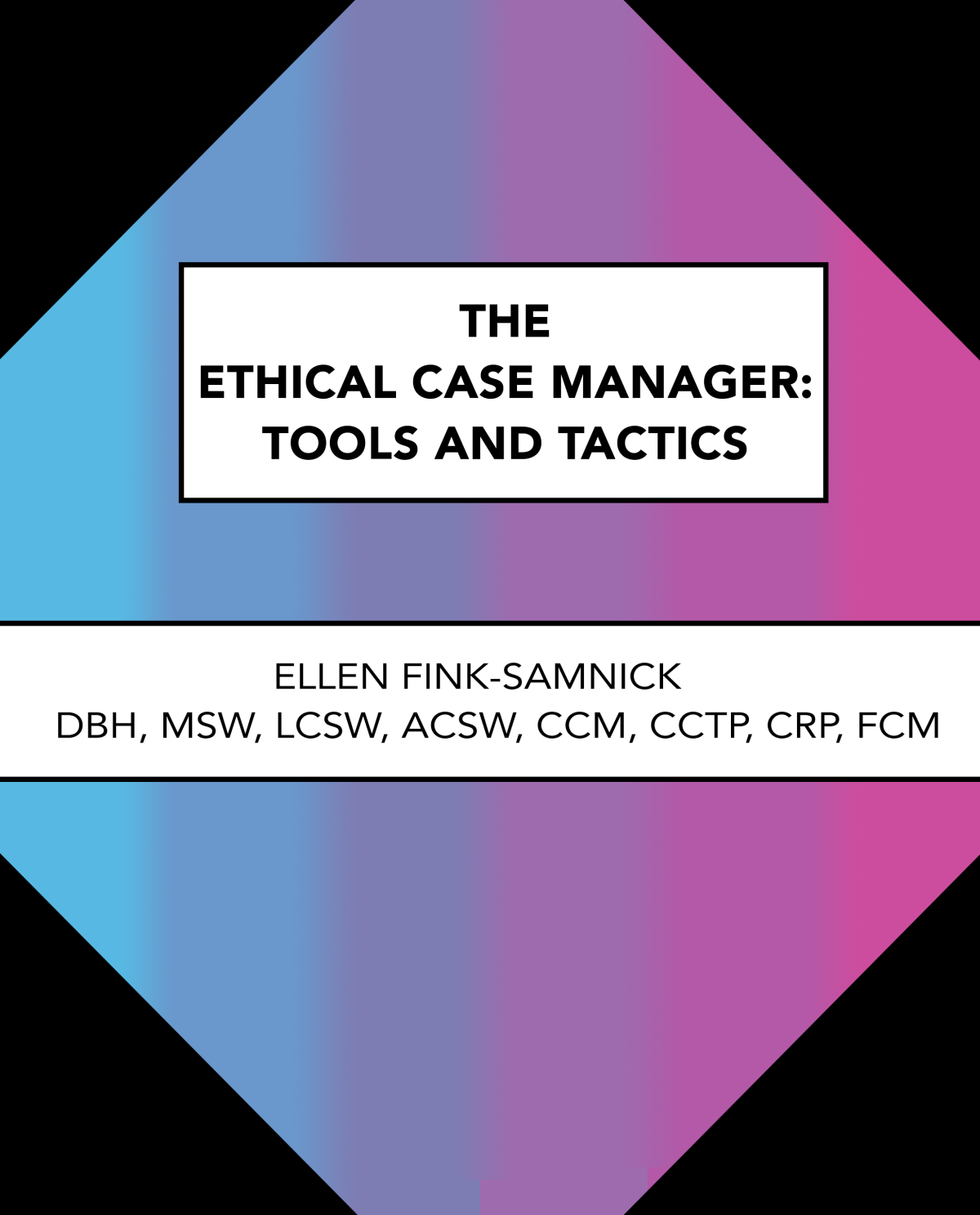
Ethics has long been viewed as not simple black and white, but varied shades of gray. Oh, how the times have changed! Ethics now comprise a spectrum of vivid colors that reflect its fierce disruptions to practice. This reality spans every health and behavioral health professional across every setting. Yet, those in case management face unique struggles. My latest book, The Ethical Case Manager: Tools and Tactics, offers clear guidance.

Unique Workforce Challenges

Case management’s workforce faces challenges not experienced by other professions. First, case management is an umbrella profession comprised of varied professions (e.g., counseling, nursing, occupational therapy, and social work). Each discipline has a distinct code of ethics or professional conduct, as well as dedicated standards of practice. Let’s add another layer of complexity that includes over 25 case management-related credentials for individuals (e.g., ACM, CCM, CDMS, CMGT-BCTM, CRC), organizations (e.g., NCQA, URAC) and their unique requirements. There are assorted professional associations across the industry, which each possess their own standards of practice. The landscape gets more confusing when we include the industry’s hierarchy of case management roles: community health workers, case management assistants, community-based case managers, board-certified case managers, and those in leadership positions. 

The question beckons: Where should your ethical compass point? The range of established resources of guidance defined by each of the above entities makes the answer to this question challenging to answer. It also yields two more confusing conundrums for the workforce:

  1. Defining the ethical and legal parameters for case management practice, and 
  2. Reconciling these parameters with employer policies and procedures across the industry.

The Ethical Case Manager to the Rescue

Here’s where, The Ethical Case Manager: Tools and Tactics comes to the rescueThe book’s content is written for an interprofessional audience that spans the spectrum of degrees held by case managers. This approach provides a context for accountability, while addressing the most complex ethical dilemmas to date.

Focus is on case management job descriptions, outcomes measurement, discharge planning, and care coordination. There’s content on digital healthcare innovation and patient assessment, addressing implicit biases, microaggressions, and health disparities. Promoting the latest domain of health equity, inclusion and belonging is covered, as is workplace bullying, licensure compacts and interstate practice.

Practical facts are blended with Federal and state regulations, tables, templates, and dedicated resources. Each chapter includes case scenarios and critical-thinking review questions for learners to apply the content. 20 Ethical Tactics provide touchpoints for learning. Every reader will reap their own reward, from students, to new and more seasoned case managers, consultants, as well as those in leadership roles.

The Ethical Case Manager’s 318 pages encompass the most vital areas for case managers:

  • Forward by Dr. Colleen Morley
  • Section 1: Essentials of Ethics
  • Chapter 1: Terms and Definitions
  • Chapter 2: Established Resources of Guidance
  • Chapter 3: The Value Proposition
  • Section 2: Realities of Practice
  • Chapter 4: Population-based Practice
  • Chapter 5: Diversity, Equity, Inclusion, and Justice (co-authored with Michael Garrett)
  • Chapter 6: Workplace Bullying
  • Chapter 7: Health Information Technology
  • Chapter 8: Interstate Practice
  • Section 3: Activation of Ethical Decision-Making
  • Chapter 9: Ethical Decision-Making Models
  • Chapter 10: Case Scenarios
  • Epilogue

The Ethical Case Manager: Tools & Tactics will be your primary resource, whether you wish to:

  • Educate students
  • Onboard new staff
  • Benchmark ethical practices
  • Resolve ethical dilemmas
  • Possess timely compliance knowledge
  • Ensure successful fiscal, clinical, and operational outcomes 
  • Use ethical decision-making models
  • Leverage interprofessional teams
  • Inform individual practices

No wonder the book is now on ANCC’s formal list of study references for their Nursing Case Management Exam (CMGT-BCTM)

*************************************************

The Ethical Case Manager: Tools and Tactics is only available on Amazon

Attending these conferences? Special access for attendees to book signing events and giveaways: