Caught in the DEI & Health Equity Crossfire?: The Current State of the Social Work Compact

The Social Work Licensure Compact is again on the move. However, will it stall amid the current DEI and Health Equity crossfire spanning the US? What will the impact be to other licensure compacts, such as those for nursing, medicine, psychology, and others?

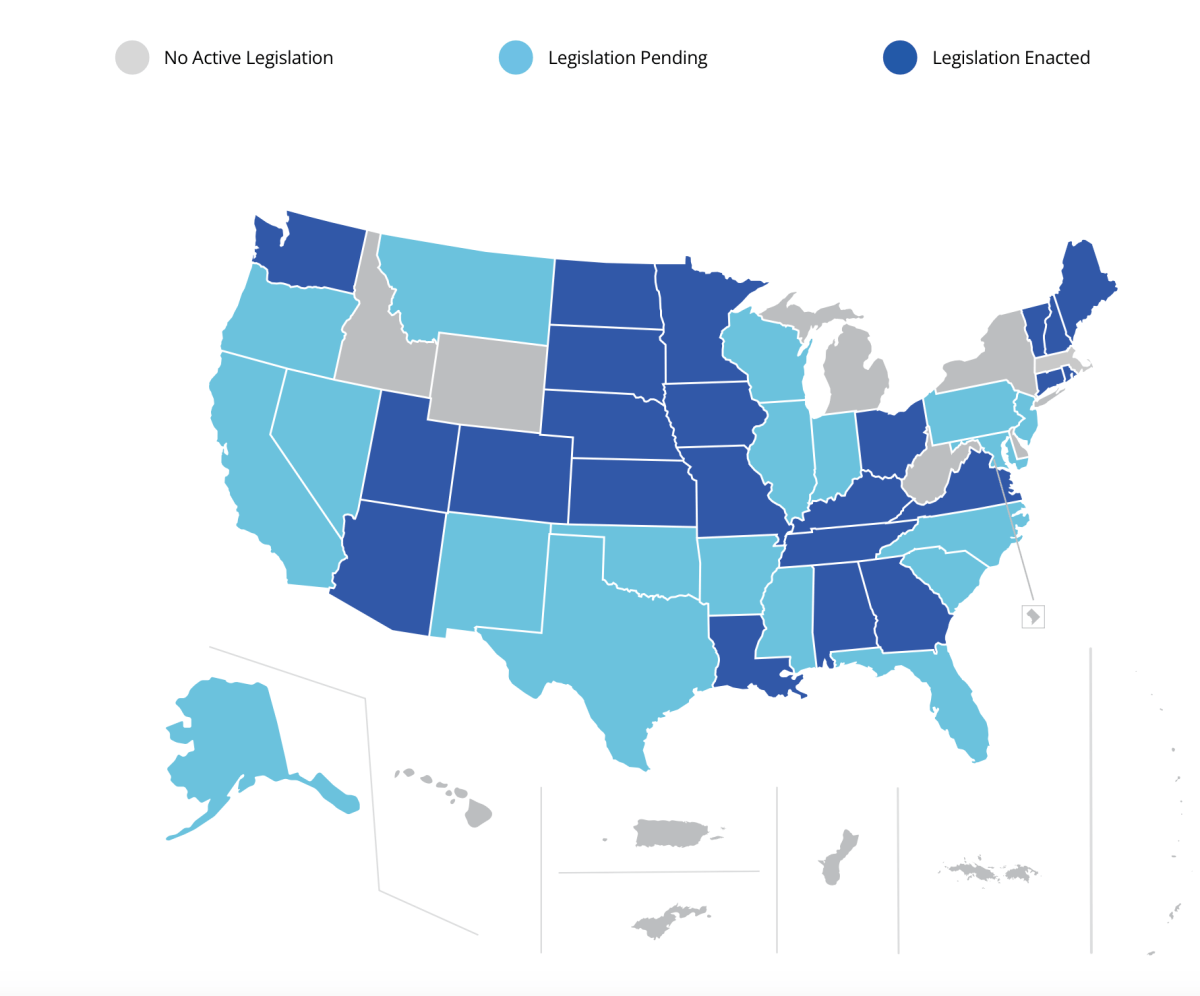
As the current state legislative session is in full swing, I thought it was a good time to review the status of the Social Work Compact. We entered the 2025 session with 24 states previously passing the Compact: Alabama, Arizona, Colorado, Connecticut, Georgia, Iowa, Kansas, Kentucky, Louisiana, Maine, Minnesota, Mississippi, Missouri, Nebraska, New Hampshire, North Dakota, Ohio, Rhode Island, South Dakota, Tennessee, Utah, Vermont, Virginia, and Washington State. The Social Work Licensure Compact Commission is advancing the formal infrastructure with the current target date for implementation by Fall 2025.

As of the time of this writing, 18 more states have stepped up with new legislation to advance the compact further: Alaska, California, Florida, Illinois, Indiana, Maryland, Mississippi, Montana, Nevada, New Jersey, New Mexico, North Carolina, Oklahoma, Oregon, Pennsylvania, South Carolina, Texas, Wisconsin. 

The Compact Landscape

There is considerable workforce commitment to advance compacts across every discipline. Contributing factors include workforce mobility and for their patient populations, along with telehealth popularity. The current state tally for compact passage across other professions includes: 

A Clear and Present Danger

Let’s get one elephant out of the corner of this room. There has been pushback by several states against the Social Work Compact due to inclusion of a requirement for passage of a standardized licensure exam. That is a valued discussion, though not the focus of this blog article.

The immediate concern to compact passage involves those states with what may be considered as more liberal rather than conservative practices or vice versa depending on your viewpoint. To practice in any compact member state, social workers must abide by laws, regulations and scope of practice of the state in which the client is located. As a result, concern has been expressed over any potential liability of workforce members should their interventions be counter to emerging legal practices for the state. Precedents for these concerns have already been defined through legal actions against our interprofessional colleagues across medicine, nursing, and other behavioral health professionals in some states. There are equal concerns about practitioners contacting ICE to report patients who present for treatment that may be undocumented. These actions are counter to professional standards previously addressed in my blog article on this topic several months ago, To Report or Not Report: Mandatory Duty to Warn for Case Management (though applicable intel for all professions). Of primary concern are states that:

  • Do not allow abortion or limit emergent medical attention to the mother in emergency situations where the health of the individual is at gross risk (e.g., miscarriages)
  • Do not allow or limit provision of resources to minors of their families for the purpose of obtaining out of state abortions in the instance of child abuse or exploitation
  • Do not allow or limit provision of resources to adults or their families for the purpose of obtaining out of state abortions for any reason including for rape, incest, or other sexual assault or intimate partner violence; this might also include providing of the morning after pill or other medical treatment guidance. 
  • Have restrictive reproductive health limits for treatments (e.g., in vitro fertilization), or other medical treatments (e.g., stem cell transplants). 
  • Do not allow or limit gender-affirming care or the provision of information on such care to minors 
  • Do not acknowledge transgender rights and access to necessary care
  • Do not acknowledge the value of concordant care across vulnerable and traditionally marginalized populations
  • Enforce cuts to Medicaid and Medicare Advantage plans that limit access to or deny services that promote patient, family, or care-giver self-sufficiency and wellness (e.g., durable medical equipment, home health care, skilled nursing facility)
  • Limit access to substance use disorder and medically-assisted treatments 
  • Do not allow use of language specific to diversity, equity, inclusion, belonging, accessibility, health equity, social justice and any aligned terminology 

There are endless examples of other concerns, along with emerging legal cases against the workforce. Some states are engaged in lawsuits against practitioners for denying emergent medical care to patients hemorrhaging from miscarriages, with mortality rates unnecessarily rising from this level of negligence. Maternal deaths in Texas have risen by close to 60% following the abortion ban. An Ohio women who suffered a miscarriage at 22 weeks of gestation in her home and sought treatment at a local hospital, initially faced criminal charges. As if the trauma of her health experience was insufficient, she was then charged with a felony; a judge ultimately dismissed the case. There are countless other similar situations. 

Moving Forward

As noted in my prior blog article, there have always been caveats to a professional’s legal and ethical obligations when religious, cultural, or other values and mores have the potential to obstruct effective care of a patient. In those situations, a safe handoff to another professional is indicated. These caveats carefully balance patient right to autonomy, self-determination, and do not harm with practitioner values. Yet, despite these protections, compact expansion has still gotten caught up in the latest values- and cultural-backlash. 

Mental health demand in the U.S. has never been higher. Given the pent-up demand for behavioral health and other services, social workers and other professionals must be able to practice across state lines. Compact expansion and social work ethics must not be allowed to suffer due to these current realities. 

The Interstate Licensure Compact Imperative

Despite interstate practice being more norm than exception, significant obstacles exist for those persons rendering and accessing care. Learn about the current Interstate Compacts and how you can advance them.

What times we are in! Providing clinical intervention and treatment can happen anywhere courtesy of telephonic platforms, plus virtual, remote, and digital products galore. Rural populations rely on these technologies to engage with their practitioners and even health plan case managers, whether for assessment or monitoring of the care process and resource linkage. Patient with disabilities can now access care with greater ease. Yet, there’s a BIG CATCH! Despite interstate practice being more norm than exception, significant obstacles exist for those persons rendering and accessing care.

The health and behavioral health workforce continues to be held hostage by lack of an inappropriate licensure portability structure. Care for consumers is obstructed amid a regulatory system that fails to account for the reality of our professional practice landscape.

Regulatory Realities Reduce Access to Care and Employment

Technology is only one driver of the need for professionals to practice across state lines. Society is more mobile than ever, both for clients and clinicians alike. Traveling practitioners (e.g., case managers, nurses, social workers) are commonly hired to fill employment gaps for staff on medical or family leave, and to mitigate workforce shortages. Yet, this sector of the workforce and their employers face chronic challenges with licensure delays, which only perpetuate barriers and limits to care for the public.

Throngs of licensed mental health providers are at the ready to provide sorely needed telehealth intervention across the states. However, care is often delayed and waiting lists for treatment grow from an antiquated licensure structure that limits one’s inability to practice across state lines. Military families move their state residence every few years and in doing so deal with financial difficulties imposed by licensure delays, and thus, employment. First responders may find their interventions are limited when disasters occur across state lines.

There are an endless list of challenges for the workforce and the public they serve. With minimal exceptions (e.g., licensed professionals who are military members, employed for military contractors), licensed professionals may only practice in the state(s) where they are licensed in good standing. How can licensed practitioners engage with their ethical and legal due diligence when their practice regulations interfere with their ability to do so?

Licensure Compacts on the Move

Licensure compacts are a viable solution for professionals seeking to be licensed in multiple jurisdictions and the that hire them. Through the compact structure, members of the workforce, such as behavioral health providers, case managers, and others who are licensed in one state can actively practice at that same level in other states which are part of the compact. The presence of a compact also reduces the economic burden faced by licensed individuals in dealing with multiple state licensure applications.

The practice of all licensed professionals is controlled by the law in the state(s) where each individual is licensed, typically by the practice act of each state. Scope of practice even supersedes academic degrees. For example, one might presume that as a Doctor of Behavioral Health, I am licensed to prescribe psychopharmacological agents to patients. However, prescribing medications is not included under the scope of practice for my licensure as an LCSW in the Commonwealth of Virginia. The scope of practice for any practitioner extends only to those activities that a person who is licensed to practice as a health professional is permitted to perform.

A change in the traditional licensure structure is mandated: one that allows health and behavioral health professionals to intervene across state and jurisdictional lines. Several professions have engaged in rigorous efforts to advocate for licensure portability through formal regulation.

Nursing

Nurses are required to be licensed in any state where they practice and where the recipient of nursing practice is located at the time service is provided. This fact is a common point of confusion for most licensed professionals—and especially tricky for those my case management colleagues. In contrast, many employers believe licensure must be held in the professional’s state of residence only, instead of where a patient may reside or is receiving care. The Nurse Licensure Compact is actively on the move, and now covers 41 states. More information is accessible on the NCSBN website.

Social Work

The lack of licensure portability has been identified as a public
safety, workforce, and technology issue
. The mandate is clear that the workforce responsible for providing the bulk of mental health services to society must be able to practice across geographic state borders. The formal language for the Social Work Licensure Compact was released in February 2023, with legislation actively being introduced across state legislatures; 24 states have done so at the time of blog post with a current map viewable on the official compact website. 4 states have fully approved the legislation: Missouri, S. Dakota, Utah, and Washington State. The Model Compact Bill must be approved by 7 states to be enacted in its entirety before its necessary infrastructure can be implemented, which is expected to happen in the coming months. After verifying eligibility, individual social workers will then be granted a multistate license, which authorizes their ability to practice in all other compact member states, and removes those longstanding barriers to interstate practice.

Counseling

The American Counseling Association Counseling Compact calls for counselors licensed in one state who have no disciplinary record, to be eligible for licensure in any state or U.S. jurisdiction where they seek residence. Like other disciplines, laws that impact counselors (e.g., mandated reporting statutes) vary from state to state, so the compact recognizes how jurisdictions may require a state jurisprudence exam. At the time of this writing, over 32 states have approved the Counseling Compact with the interactive map viewable on the compact site.

Compacts on the Move

In addition to the compacts listed, further information is available for those covering:

Individual practitioners must engage in advocacy efforts through their respective professional associations. Many of these entities have fierce public policy committees that work diligently to support interstate practice. In addition, contact local legislators to provide individual support for those licensure compacts of interest to you. Access your elected legislators through USA.gov. Remember, support for one interstate compact, leverages them all!

What to find out more on Interstate Compacts, and the Do’s and Don’ts of practice across state lines?? Read Chapter 8 in The Ethical Case Manager: Tools and Tactics, available on Amazon.